Researcher at TU Delft in Sebastian Feld group. I am an ex postdoc with Sabrina Maniscalco at University of Helsinki. I completed my PhD with Jarek Miszczak @ IITiS, Poland. My PhD Thesis. For last 5 years I’m working in the intersection of classical machine learning and quantum computing, leveraging near-term quantum hardware and beyond with advanced RL methods. My expertise is in Quantum Architecture Search. Excluding reading my hobbies are: Biking, watching Summoning Salt, listening to Summer Salt, stumbling upon Untitled YouTube Videos, Goppo Mir er Thek, and Advaita Vedanta. Contact me via email: kunduaku339 [at] gmail [dot] com. My true self Resides Here.
Serving as a reviewer for NeurIPS 2025, 2026, ICLR 2026, Nature Comm. Phys., IOP MLST, Neural Networks, ACM TQC.
Serving as a Editor for Frontiers in artificial intelligence, Discover quantum science, frontiers in quantum science and technology.
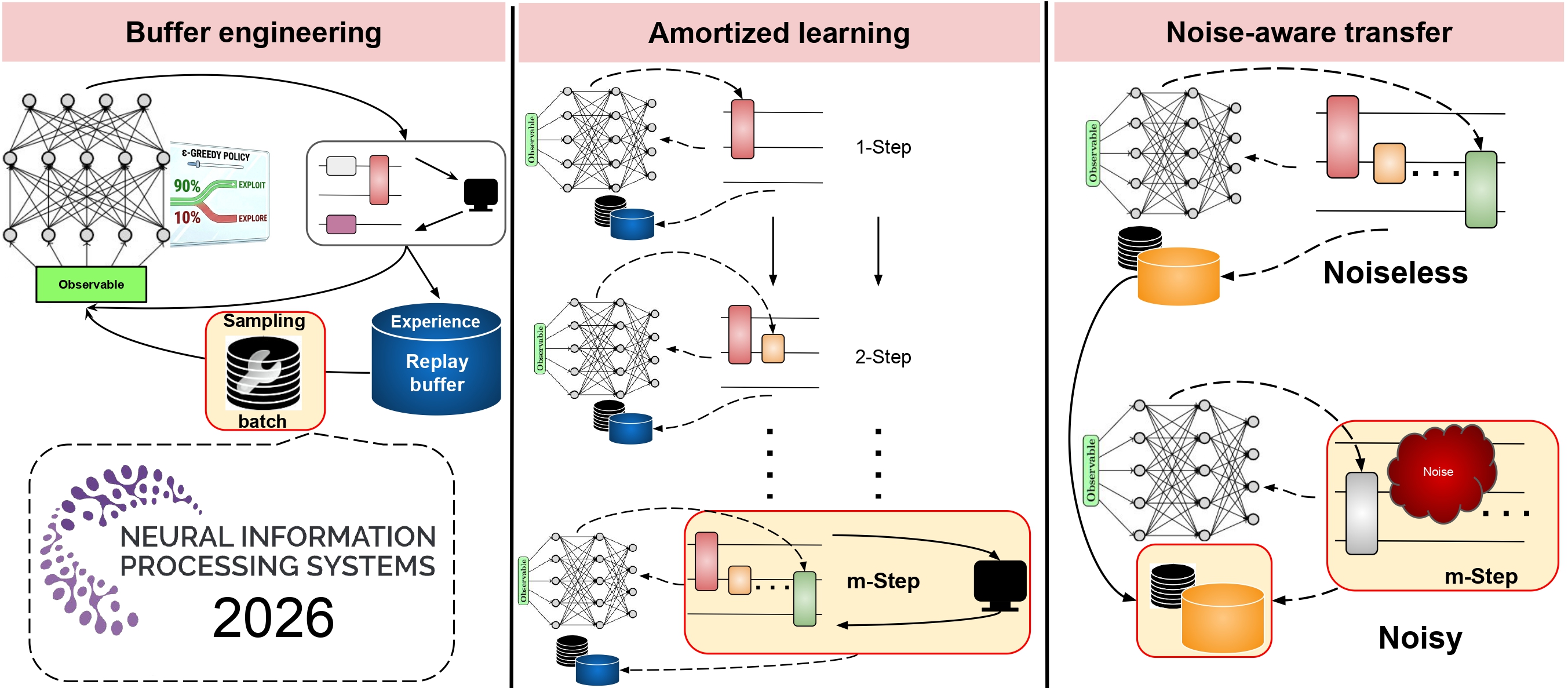
Our paper available on arXiV argues that the replay buffer is not just a storage component, but a central algorithmic lever for quantum RL. It introduces three related ideas: an annealed replay strategy called ReaPER+, a curriculum RL method called OptCRLQAS that reduces repeated expensive quantum-classical evaluations, and a lightweight transfer scheme that reuses noiseless trajectories to accelerate noisy hardware training. Key findings:
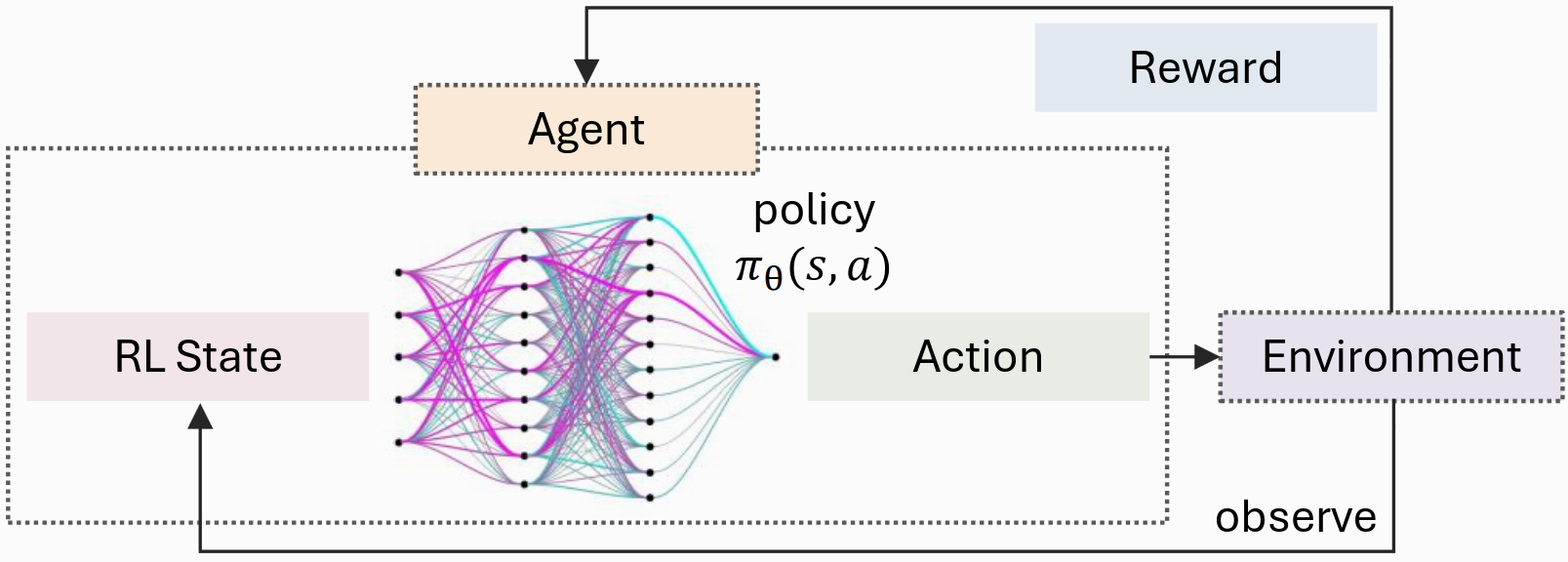
This review available currently at OpenReview synthesizes progress in reinforcement learning for quantum circuit optimization (RL-QCO), framing the field as a sequential decision-making problem over circuit construction, compilation, routing, and rewriting. It organizes the literature around four core MDP design choices — state, reward, action space, and agent — and uses that lens to compare approaches across variational ansatz search, unitary synthesis, qubit mapping, ZX-calculus simplification, and fault-tolerant resource reduction. Key findings:
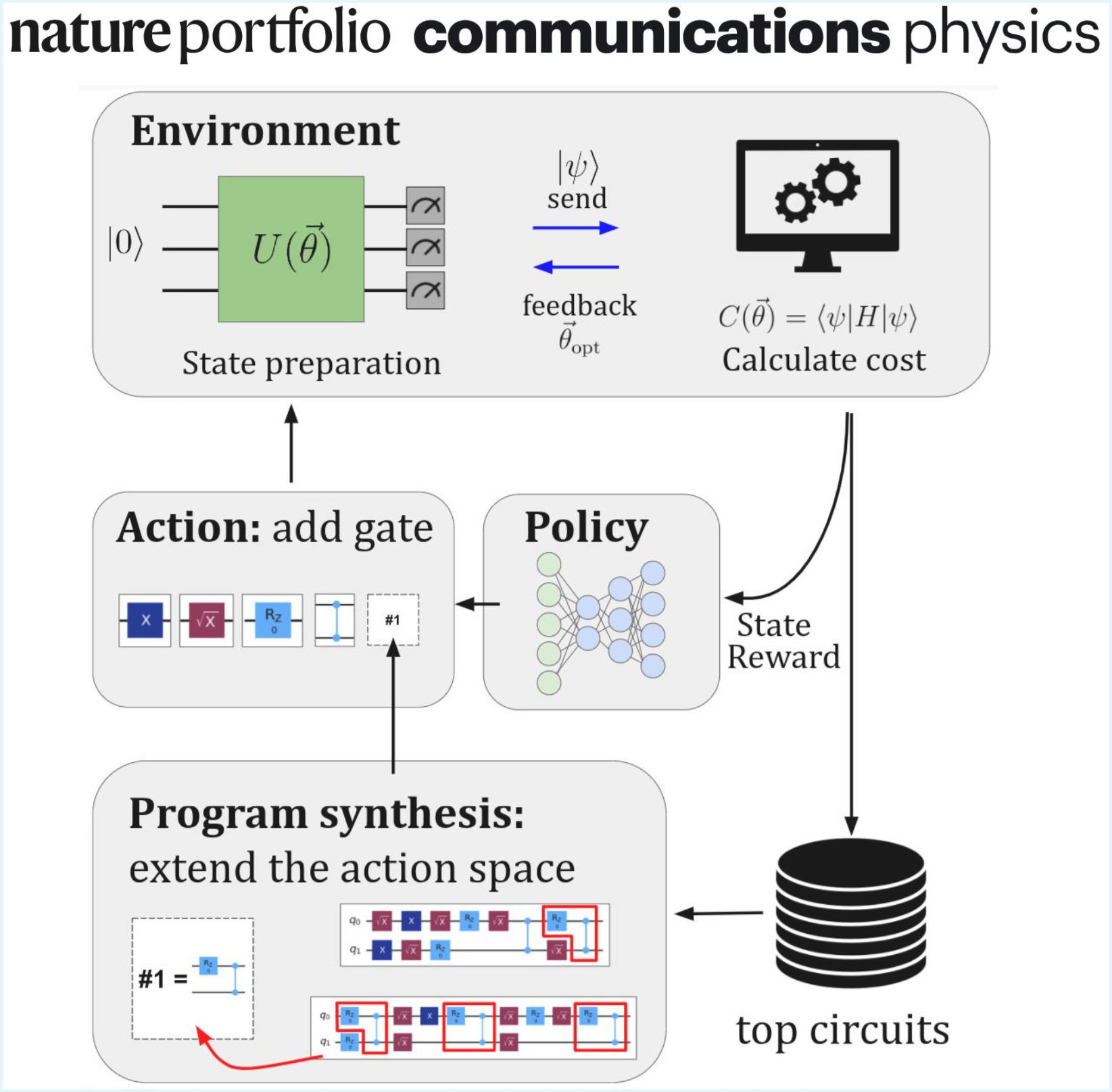
Introducing Gadget Reinforcement Learning (GRL), a novel framework that combines reinforcement learning with program synthesis to automatically design quantum circuits that respect hardware constraints. By constructing composite gates that expand the action space while maintaining hardware compatibility, GRL overcomes the accuracy limitations of existing RL-based methods when restricted to hardware-native gates. Key findings:
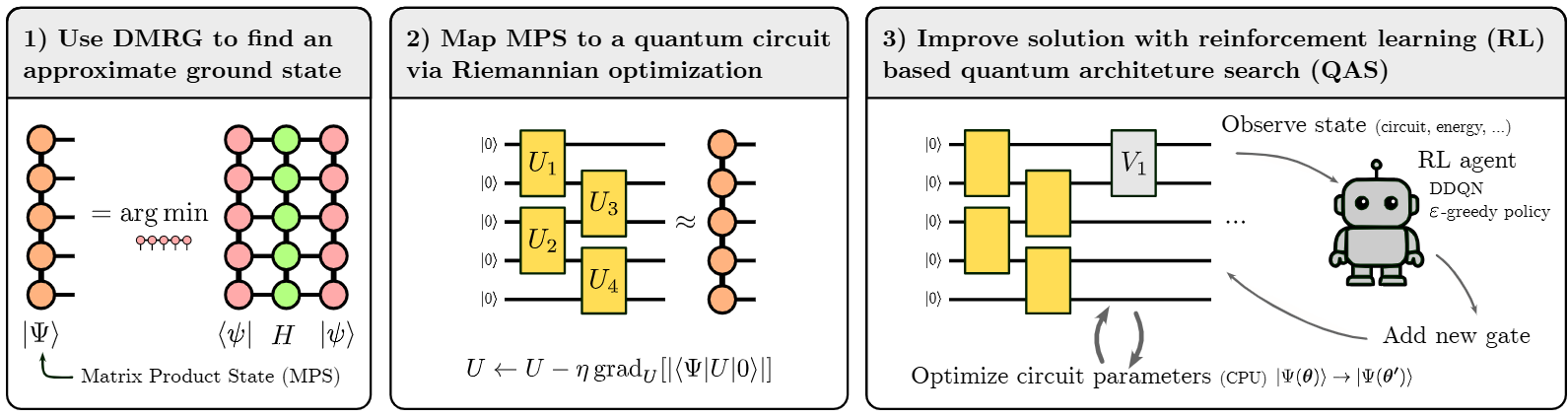
Introducing TensorRL-QAS, an improved QAS framework that combines tensor network (TN) methods with RL for designing quantum circuits. By warm-starting the architecture search with a matrix product state approximation of the target solution, TensorRL-QAS effectively narrows the search space to physically meaningful circuits, accelerating convergence to the desired solution. Key findings:
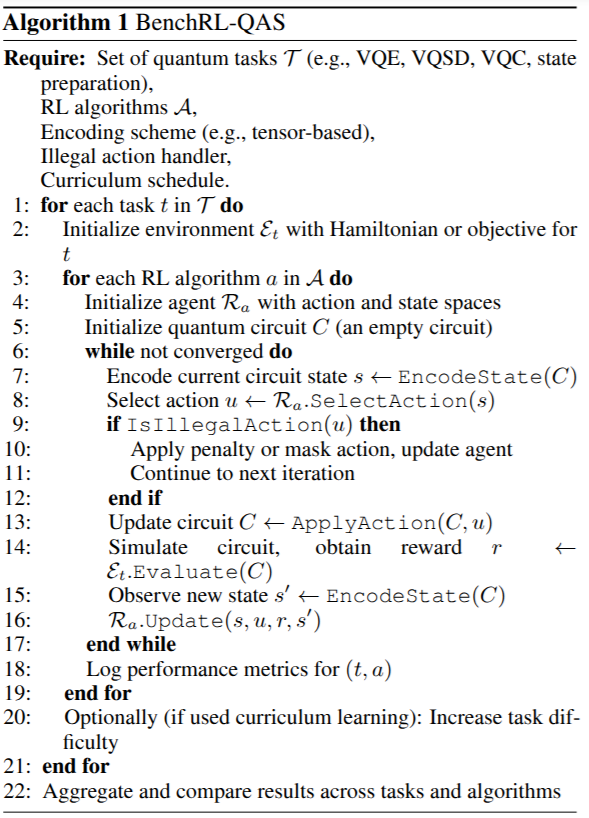
BenchRL-QAS, is a unified benchmarking framework for systematically evaluating reinforcement learning (RL) algorithms in quantum architecture search (QAS) across diverse variational quantum algorithm tasks and system sizes ranging from 2- to 8-qubit. This work represents the most comprehensive RL-QAS benchmarking effort to date. Huge shout-out to my interns Aditi Das, Azhar Ikhtiarudin and Param Thakkar! Our primary findings are:
A curated list of standout libraries, tutorials, research papers, and essential resources focused on Quantum Architecture Search (QAS). This collection is designed to serve as a structured and thorough reference, empowering researchers and developers to accelerate their work and stay at the forefront of QAS advancements. The repository contains:
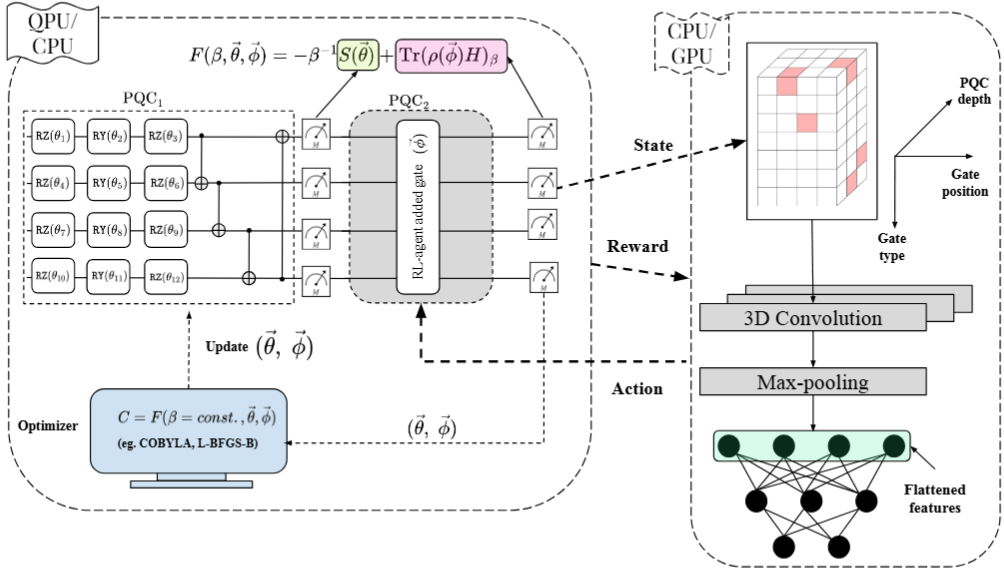
The SYK model, known for its strong quantum correlations and chaotic behavior, serves as a key platform for quantum gravity studies. However, variationally preparing thermal states on near-term quantum devices for large systems presents a significant challenge due to the rapid growth in the complexity of parameterized quantum circuits. We address this by combining reinforcement learning with convolutional neural networks, iteratively refining the quantum circuit and its parameters using a composite reward signal from entropy and SYK Hamiltonian expectation values. Key findings: